
Every so often, marketing stops behaving like marketing and starts behaving like culture. That’s what happened when Stranger Things returned. Netflix didn’t raise its voice. It didn’t flood feeds with reminders or plead for attention. It simply showed up with confidence and let the world notice.
One of the clearest signals came from an unlikely place: search.
Type “Stranger Things” into Google, and something unexpected happens. A small Dungeons & Dragons dice appears. Click it, and the entire search experience transforms. The screen darkens. Text flips upside down. Atmospheric effects ripple across the page. For a moment, you’re no longer searching the internet, you’re inside the Upside Down.
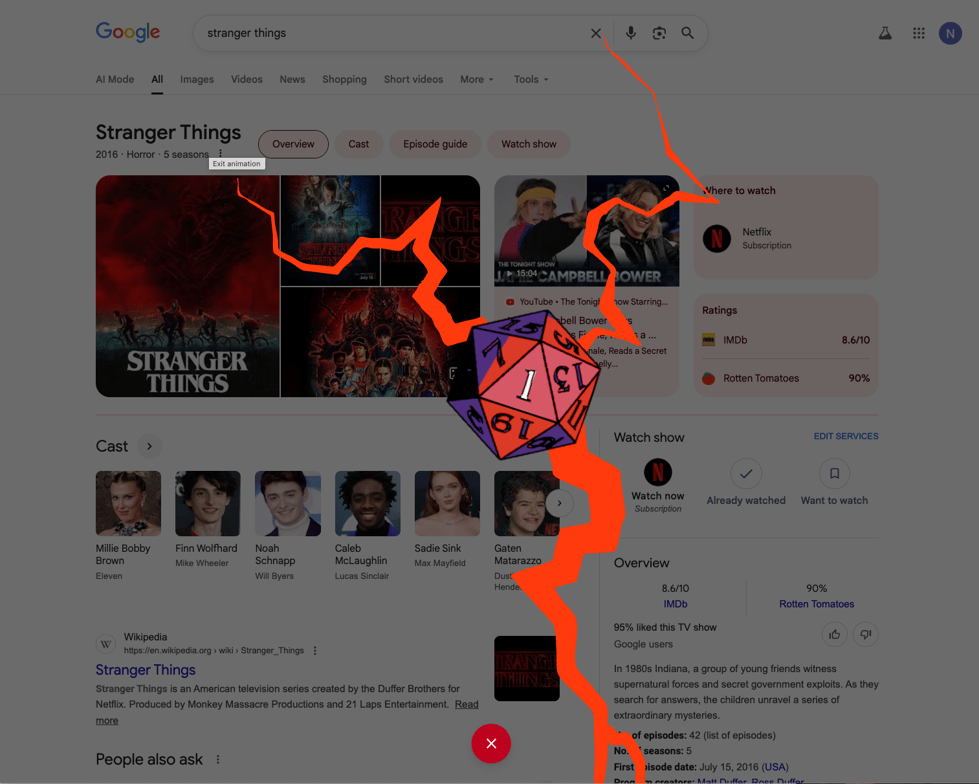
That wasn’t an ad.
That was an experience hiding in plain sight.
It’s easy to overlook how radical that is. Search is usually the most transactional space on the internet. Type. Scan. Click. Move on. But here, even the act of looking something up became part of the story. The campaign didn’t stop at billboards or pop-ups or social feeds. It extended into the very place people go to make sense of what they’re seeing.
This wasn’t promotion in the traditional sense. It was presence. The campaign slipped into everyday life in ways that felt unsettling, playful, and deliberate. Billboards didn’t explain themselves. Pop-ups didn’t feel transactional. Social content didn’t summarize the show. Even search refused to behave normally. Every touchpoint felt like a clue, an invitation, a subtle disruption that made people pause and look twice.
What Netflix understood is something many brands still miss: attention no longer responds to volume. It responds to meaning. In a world saturated with messages, people protect their focus. They don’t give attention to what asks for it. They give attention to what feels worth their time.
Rather than shouting louder, Stranger Things leaned into intrigue. It trusted curiosity to do the heavy lifting. And when curiosity takes over, behavior changes. People stop scrolling. They start searching. They talk. They share. They participate.
That’s where something quietly important happened. Search didn’t lead this campaign. It followed it. People weren’t responding to ads or keyword strategies. They were trying to understand what they had just experienced. The surge in searches wasn’t driven by optimization. It was driven by wonder. Even Google, typically the starting point of discovery, became part of the narrative instead of the navigator.
This is the distinction most brands overlook. Ads ask for attention. Experiences earn it. An ad says, “Look at me.” An experience says, “Step inside.” Stranger Things chose the latter, and the audience responded by leaning in rather than tuning out.
What made the campaign especially powerful was restraint. Netflix trusted its audience. It trusted people to be curious, to click the dice, to connect dots, and to spread the story without being instructed to do so. That kind of confidence is rare. And it signals something deeper: respect for the audience and a clear understanding of how attention actually works today.
Stranger Things didn’t just launch a new season. It raised expectations for what marketing can be. In an era where brands compete not just with other ads but with real life itself, the bar has moved. If what you put into the world doesn’t feel like something people would choose to engage with, no amount of media spend will save it.
Attention today isn’t bought. It’s granted.
And Stranger Things earned every second of it.