
Know who you are building for
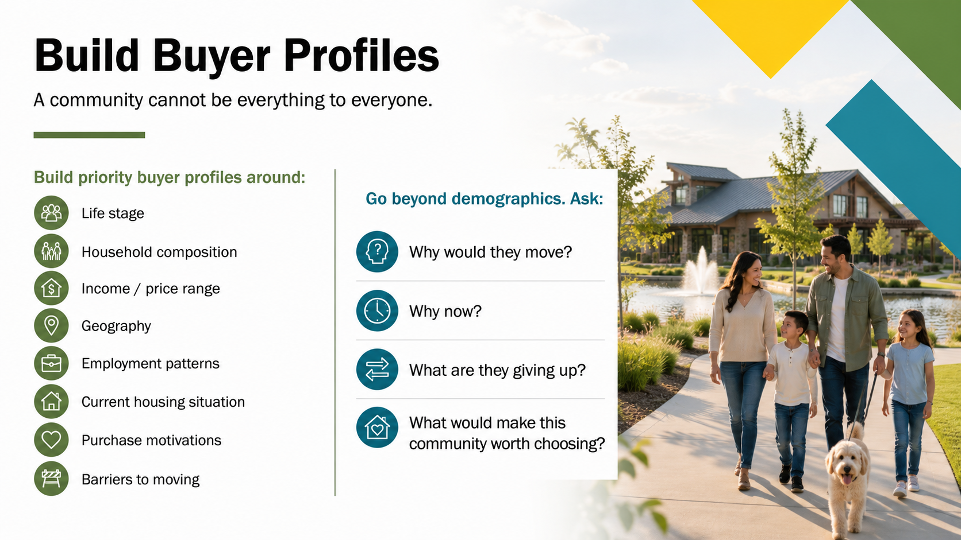
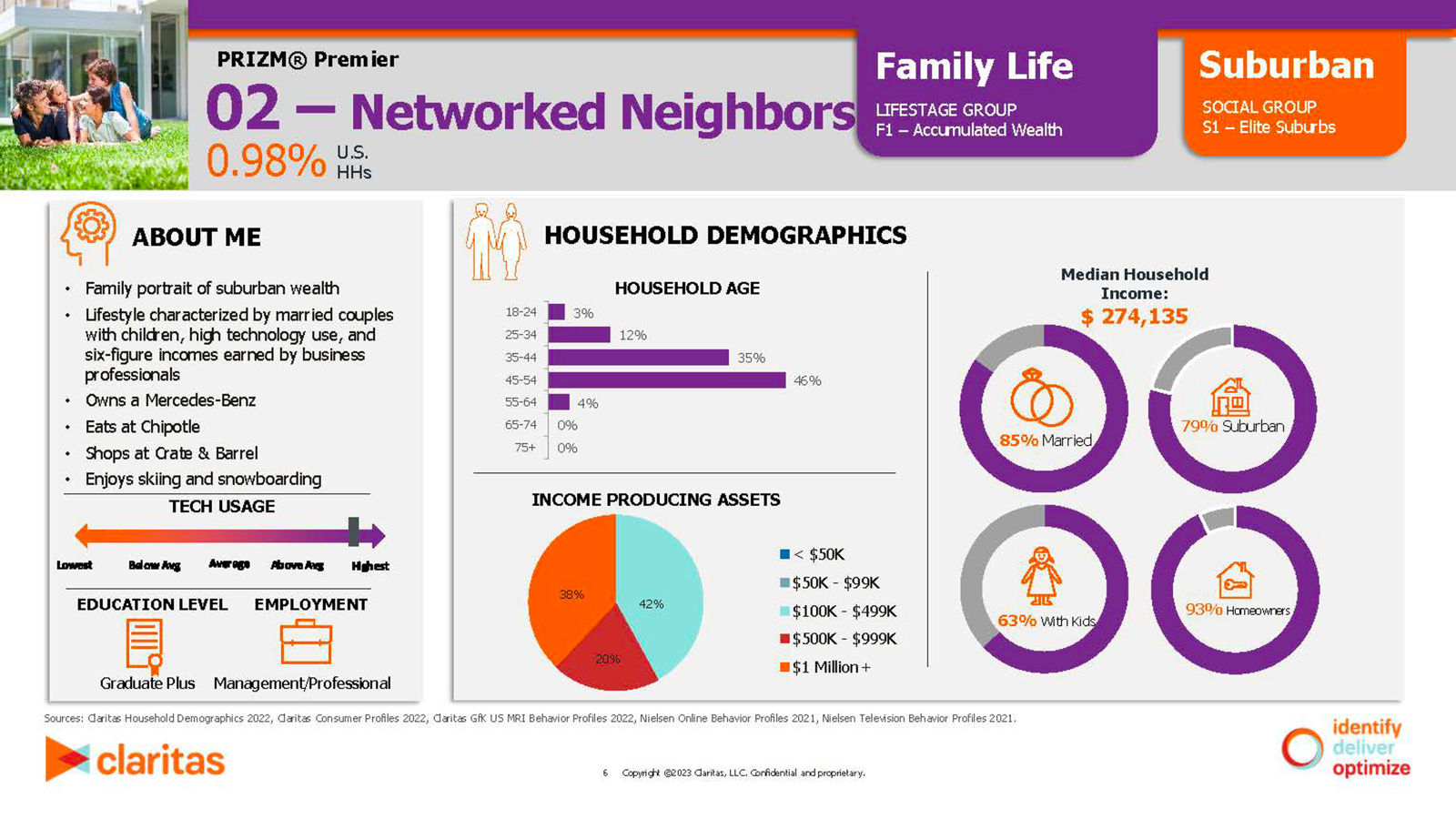
Use demographics, geography, price, life stage, behavioral data, Realtor insight, and emotional motivations to define priority audiences rather than marketing to everyone.
Master-Planned Community Marketing
THE STRATEGY
Use demographics, geography, price, life stage, behavioral data, Realtor insight, and emotional motivations to define priority audiences rather than marketing to everyone.
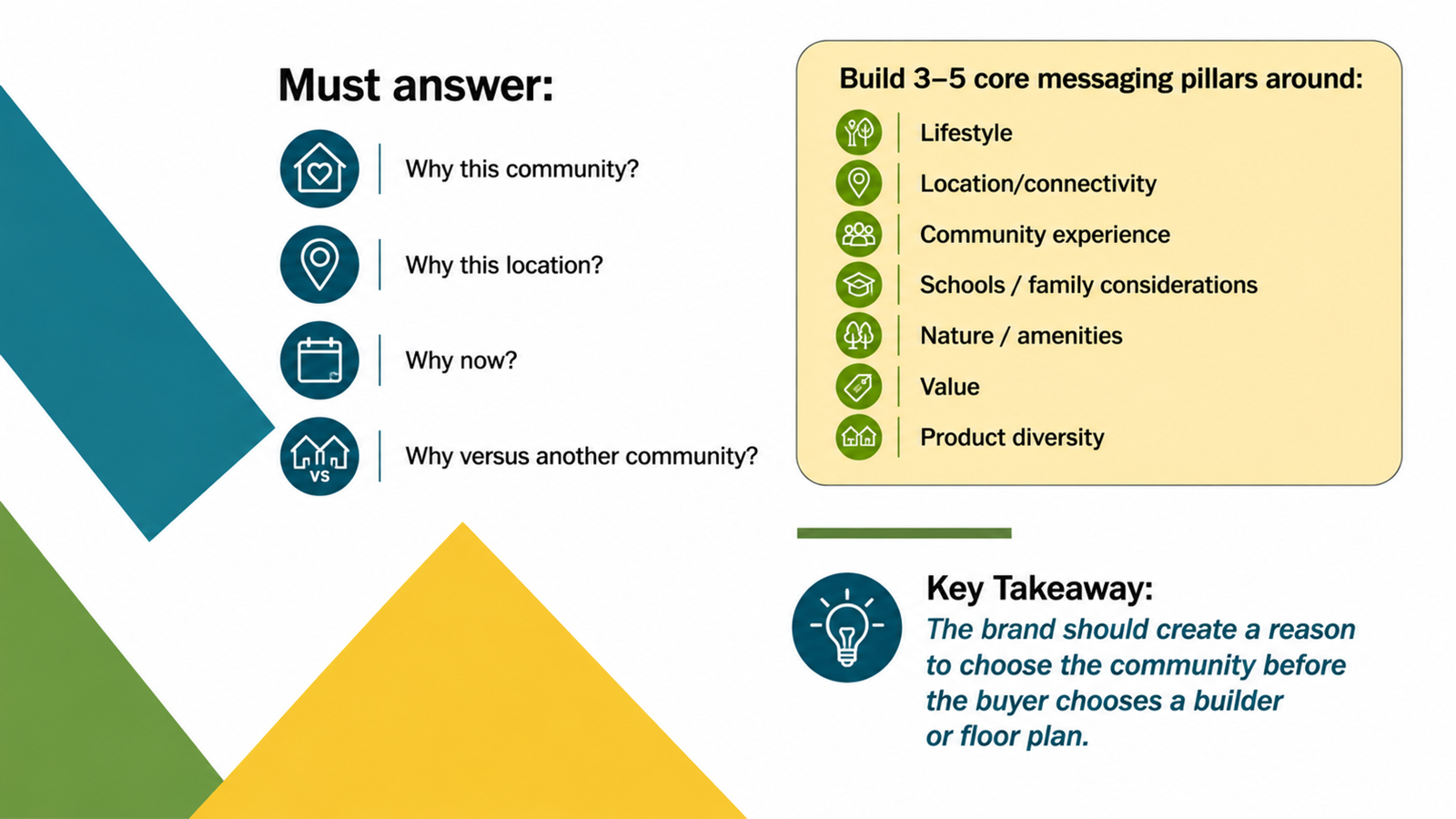
Answer why this community, why this location, why now, and why versus competing communities. Build 3–5 consistent messaging pillars around that position.
Make parks, trails, schools, connections, events, nature, retail, employment access, and the future community experience tangible, even before the full vision is built.
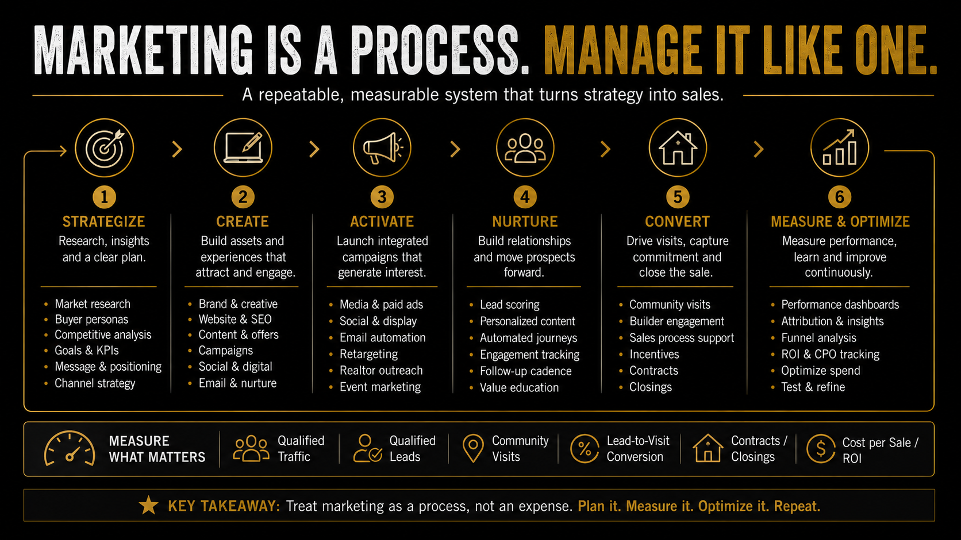
Every channel should have a job: create awareness, generate research, identify prospects, drive visits, support model-home traffic, or contribute to contracts.
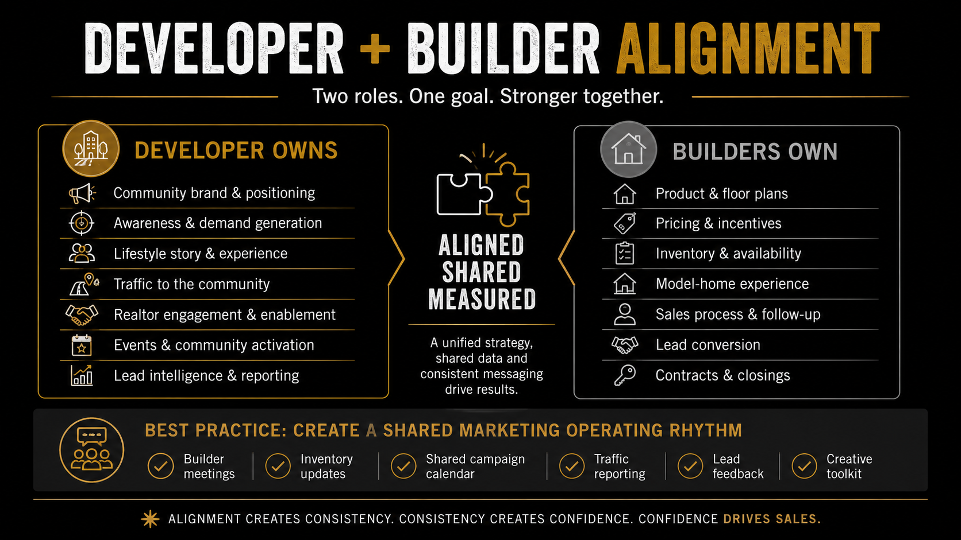
Give builders consistent community messaging, creative assets, traffic-driving campaigns, events, Realtor support, and lead intelligence without surrendering the community brand.
Make the community easy to understand, recommend, visit, and sell through broker outreach, events, useful sales tools, database marketing, and consistent education.
“If every competing community could say the same thing, it isn't positioning.”

DEMAND GENERATION
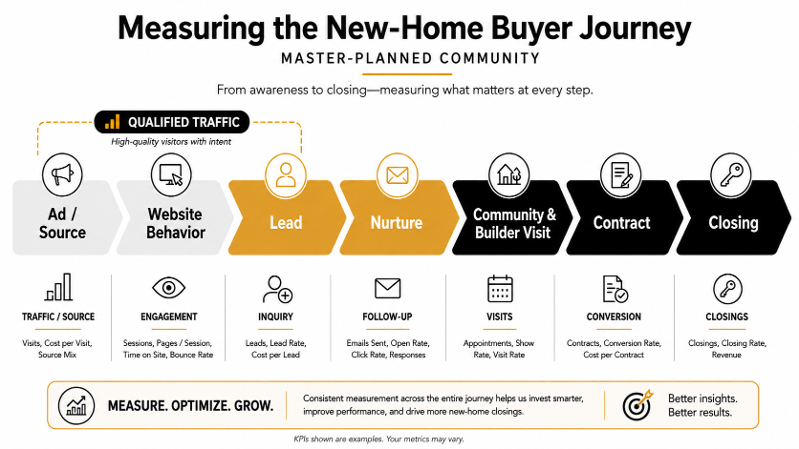
| Stage | Primary Executive KPI | Useful Supporting Metrics | Developer Question |
|---|---|---|---|
| Awareness | Qualified reach | Impressions, frequency, video completion, branded search | Are enough of the right people aware the community exists? |
| Interest | Engaged prospects | Engaged sessions, content views, CTR, maps/amenity engagement | Is the positioning creating curiosity? |
| Website | Qualified website traffic | Builder pages, floor plans, location content, returning users | Are prospects actively researching the community? |
| Lead | Qualified leads | Information requests, event registrations, Realtor leads, email signups | Are anonymous shoppers becoming identifiable prospects? |
| Nurture | Lead engagement & progression | Email engagement, return website visits, content engagement, appointment intent, lead-score movement | Are prospects staying engaged and moving closer to a visit? |
| Community & Builder Visit | Qualified physical traffic | Directions, appointments, welcome-center/model traffic, builder registrations, models visited, repeat visits | Is marketing turning interest into meaningful on-site shopping activity? |
| Home Purchase | Contracts / closings | Cost per sale, lead-to-sale, visit-to-sale, cancellations | Is marketing supporting required absorption? |
High reach with low website traffic suggests a message or targeting issue. High leads with weak nurture engagement suggests lead quality, relevance, or follow-up issues. Strong nurture with low community/builder visits suggests appointment conversion or visit motivation. High on-site traffic with low contracts can point to product, pricing, inventory, financing, or sales execution, not necessarily marketing.
BUDGET PHILOSOPHY
ON-TARGET! CLIENT STORIES
Falls at Imperial Oaks was relying heavily on builder incentives and third-party activity while sales were materially below projections. On-Target! repositioned the community and built an integrated engine using digital campaigns, content, direct mail, outdoor, events, persona-based landing pages, automation, funnel optimization, and Realtor engagement.
243% year-over-year sales increase; sold out 3 years early.Read the Holcomb Properties client story →For Lakes of Bella Terra, a competitive Fort Bend launch required fast awareness and conversion across multiple buyer segments. The strategy combined Realtor and market insight, search, social, video, events, outdoor, targeted landing pages, lead nurturing, consistent brand execution, and continuous optimization.
Qualified buyer volume, sustained sales performance, and lower CPC.Read the Ryko Development client story →Trend faced larger, better-funded competitors and needed efficiency rather than brute-force spending. On-Target! used buyer-persona analysis, tailored conversion experiences, sales-funnel optimization, automation, brand repositioning, and market expansion strategy to improve the productivity of the budget.
Higher velocity, stronger ROI, and expanded reach.Read the Trend Development client story →FREQUENTLY ASKED QUESTIONS
There is no single universal percentage. Recent studies over the past 5 years post Covid state a varying range from .68% to 1.2% of total home sales. So, for a 1,000 home MPC with an average sale price of $450,000 = $450,000,000 in total sales. Multiplied by recent trends meand planning budget range between $3,060,000-$5,400,000.
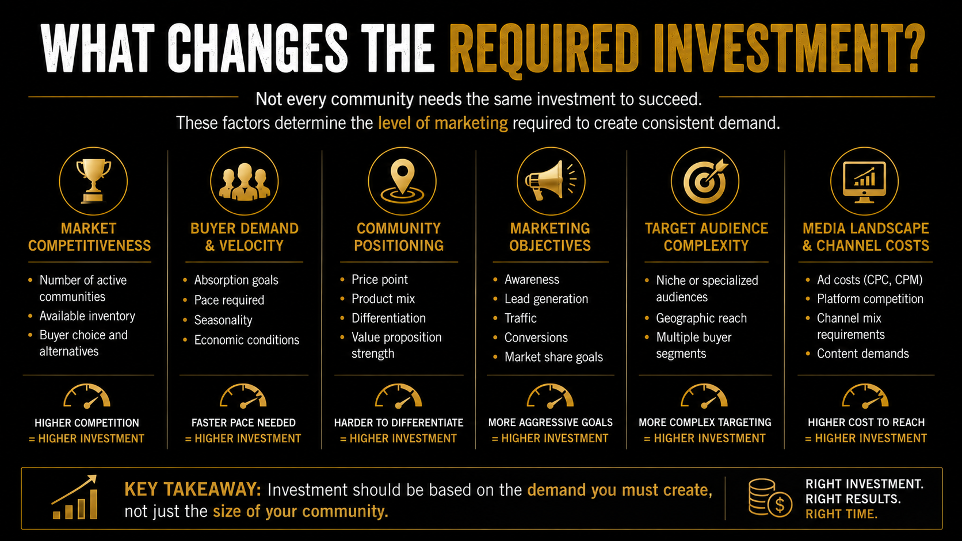
The required investment depends on community size, number of builders and active phases, market competitiveness, launch requirements, selling timeline, product position, and most importantly, the absorption rate the developer needs to achieve. Use the calculator above as a planning range, then calibrate it with actual market and sales data.
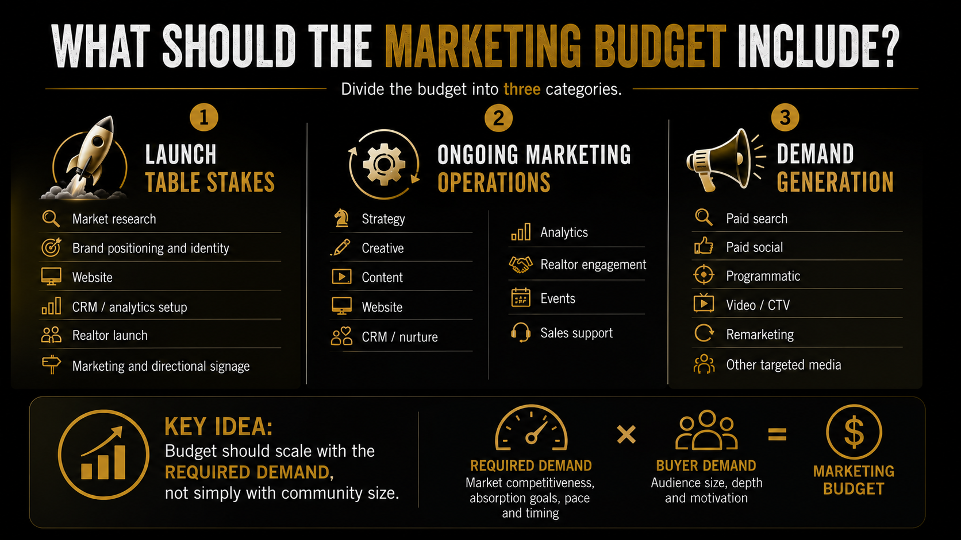
At a minimum: marketing research, positioning and brand identity, a community website, CRM/analytics and lead tracking, Realtor-market initiation, and marketing/directional signage. Major monument or infrastructure signage should generally be treated separately from the marketing budget.
A compressed sellout timeline requires more qualified demand in a shorter period. That generally means greater reach, more frequency, broader audience capture, stronger Realtor activation, more creative refreshes, heavier remarketing, and more consistent traffic-generation support. The calculator makes the premium substantially steeper above 30% annual absorption.
They have different jobs. The developer should own community positioning, destination awareness, lifestyle messaging, Realtor/community engagement, traffic generation, and the overall brand system. Builders should convert that community demand with product, pricing, inventory, model-home experience, and sales follow-up.
Keep executive reporting tied to the funnel: qualified reach, qualified website traffic, leads, nurture engagement, community/builder visits, contracts and closings, cost per sale, and actual absorption versus plan. Channel metrics such as CTR and CPC are useful diagnostic indicators, but they are not the business outcome.
A Builder Marketing Fee is typically calculated as a per-home or per-lot contribution toward the master-planned community’s overall marketing budget, with current market fees often ranging from approximately $1,000 to $4,500 per home on average.
The right amount should not be chosen arbitrarily. Start with the total marketing investment required to achieve the community’s planned absorption, determine how much of that investment should reasonably be funded by participating builders, and divide that contribution across projected home sales.
For example, if a community expects 800 home sales and determines that builders should collectively contribute $2 million toward community-level marketing, the average Builder Marketing Fee would be approximately $2,500 per home.
More sophisticated agreements may establish a base fee with adjustments or claw-backs tied to actual sales price, sales velocity, or other performance measures. This can help keep the contribution equitable when builders offer significantly different price points or when actual absorption differs from the original development plan.
A Builder Marketing Fee should generally help fund programs that benefit all builders, including:
The important distinction is that the Builder Marketing Fee is usually a funding mechanism for the community marketing program—not the marketing strategy itself. The developer still needs to determine the total investment required to generate enough qualified demand to achieve the desired absorption rate.
In most cases, Builder Marketing Fees should fund only a portion of the total master-planned community marketing budget rather than determine the budget itself.
A common mistake is to calculate the available marketing dollars by multiplying the number of anticipated closings by an arbitrary builder fee and then treating that figure as the marketing budget.
The process should work in the opposite direction.
First determine:
Required absorption → Required demand → Required marketing investment → Appropriate builder contribution
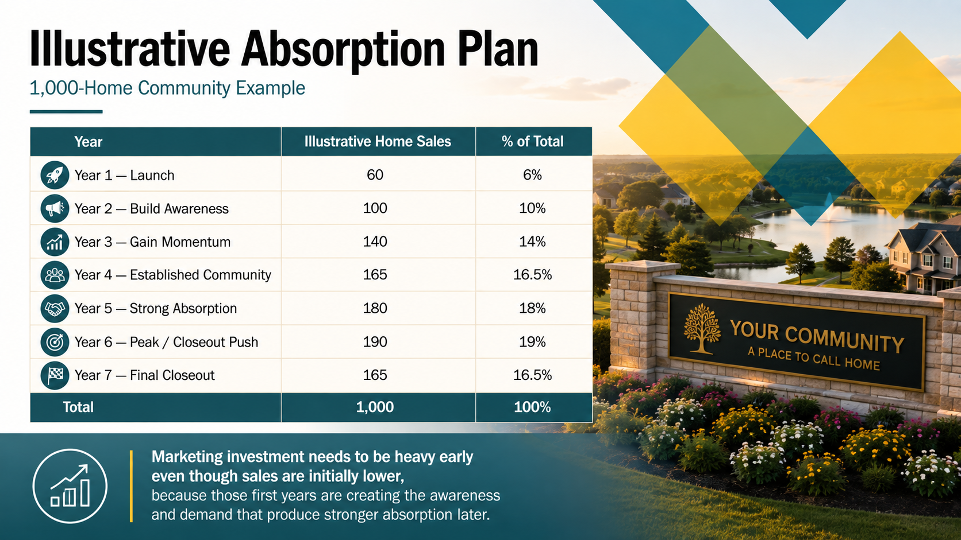
The developer may need to supplement builder contributions substantially during the early years of the community, particularly during brand launch, model openings, amenity introductions and periods when relatively few homes are closing.
This is especially important because marketing expenses frequently occur before the closings that generate Builder Marketing Fees.
Developers should therefore model both the total lifetime marketing requirement and the timing of cash flow rather than assuming builder contributions will completely finance demand generation.
Marketing for a new master-planned community should typically begin several months before the first model homes open so awareness, Realtor interest and buyer demand already exist when builders are ready to sell.
Waiting until homes are available means starting the demand engine at the same moment the development begins depending on sales.
Before opening, the developer should already be establishing:
For communities entering competitive submarkets, early marketing can also help establish the community's position before competing developments define the market conversation for you.
The goal isn't necessarily to generate thousands of early leads. It is to create enough familiarity and curiosity that buyers and Realtors already recognize the community when homes become available.
A new master-planned community should budget separately for pre-opening marketing because many of the most important marketing investments occur before the first home closing generates revenue.
Those early expenses can include research, positioning, naming and branding, website development, signage, photography and visualization, CRM infrastructure, Realtor outreach, creative development, media planning, pre-opening advertising and launch events.
For a homebuilder self-developing a community, this is an especially important budgeting distinction.
Marketing the builder's homes and marketing the community itself are different investments. The builder already has a corporate brand, but the new development still needs its own market position, destination story and demand-generation strategy.
A realistic development pro forma should therefore include community marketing as an early development investment, rather than expecting future builder fees or home-sale revenue to cover every startup expense.
In most case the answer is Yes—a homebuilder self-developing a community benefits from creating a distinct community brand while allowing the builder brand to provide credibility and product support.
Buyers make two related decisions:
Do I want to live here?
and
Do I want to buy this house?
Those are not exactly the same question.
The community brand should sell the location, lifestyle, amenities, character, schools, connectivity and future vision of the place. The builder brand should sell the homes, floor plans, construction quality, available inventory and buying experience. In a "Leech" community play, where the builder attempts to attract existing area demand from more visible communities, it is important to position cross-sell angles to effectively attain market share goals.
Creating some separation also provides strategic flexibility. If additional builders are added later, the community can remain larger than any individual builder.
For a self-developing builder, the strongest approach is usually not to hide the builder relationship but to establish a clear hierarchy:
Community creates preference. Builder converts preference into a home sale.
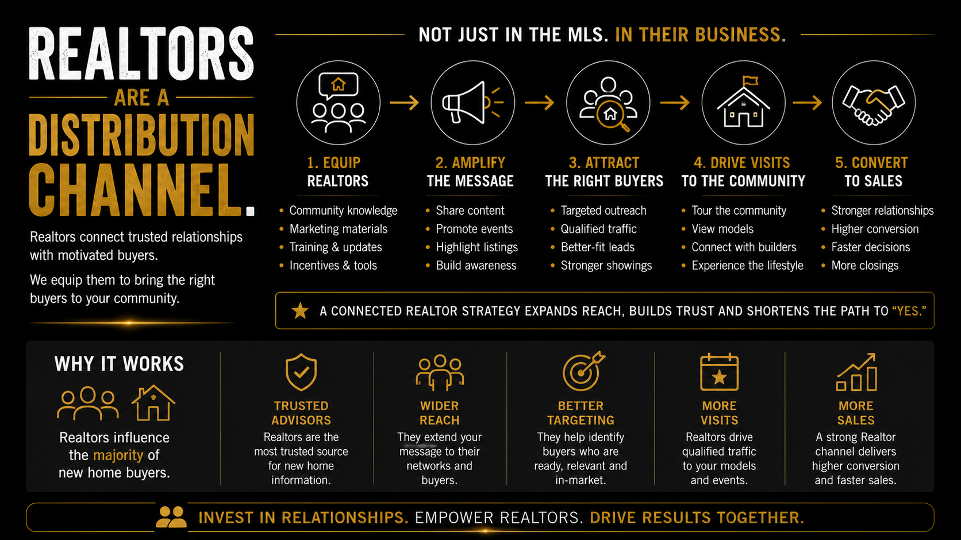
Realtors should be treated as a major distribution channel for a master-planned community because they can influence where buyers begin their home search, which communities they visit and which alternatives they consider.
Realtor marketing should extend beyond occasional broker lunches or grand-opening invitations.
An effective MPC Realtor strategy can include:
The objective is to make the development easy for an agent to understand, remember, recommend and show.
This becomes especially important when a new community lacks the name recognition of established developments nearby.
An MPC marketing budget may be too low when the community consistently fails to generate enough qualified buyer and Realtor activity to support its planned home-sales absorption rate.
The answer cannot be determined from media spending alone.
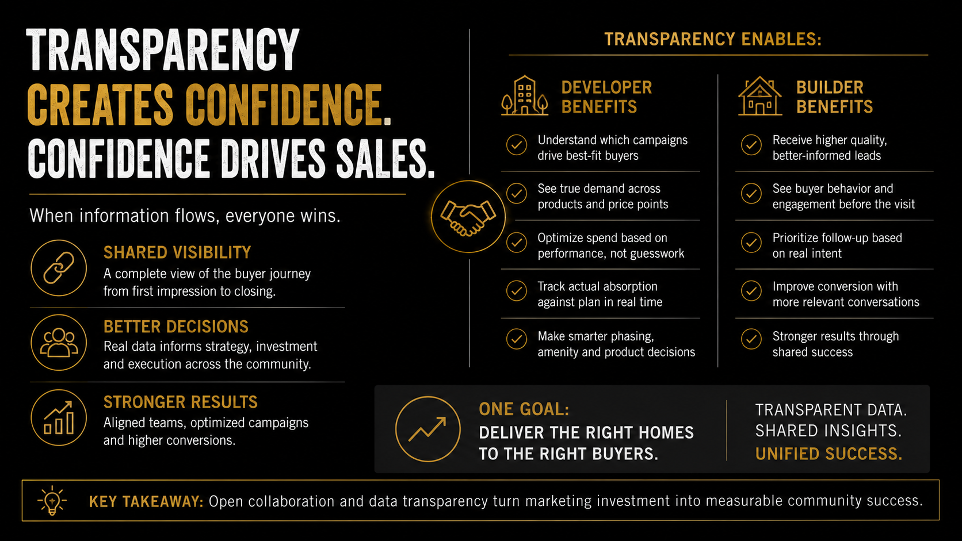
Developers should examine the entire demand funnel:
Awareness → Website Traffic → Leads → Nurture → Community Visits → Builder Visits → Contracts → Closings
Where the funnel breaks provides clues.
Low awareness may indicate insufficient reach or media pressure. Strong website traffic but few leads may indicate weak positioning or conversion. Good lead volume but poor community traffic may reveal a nurturing or appointment problem. Strong traffic but weak contracts may point toward pricing, product, inventory, financing or sales execution instead of marketing.
The critical comparison is ultimately:
Actual absorption vs. planned absorption.
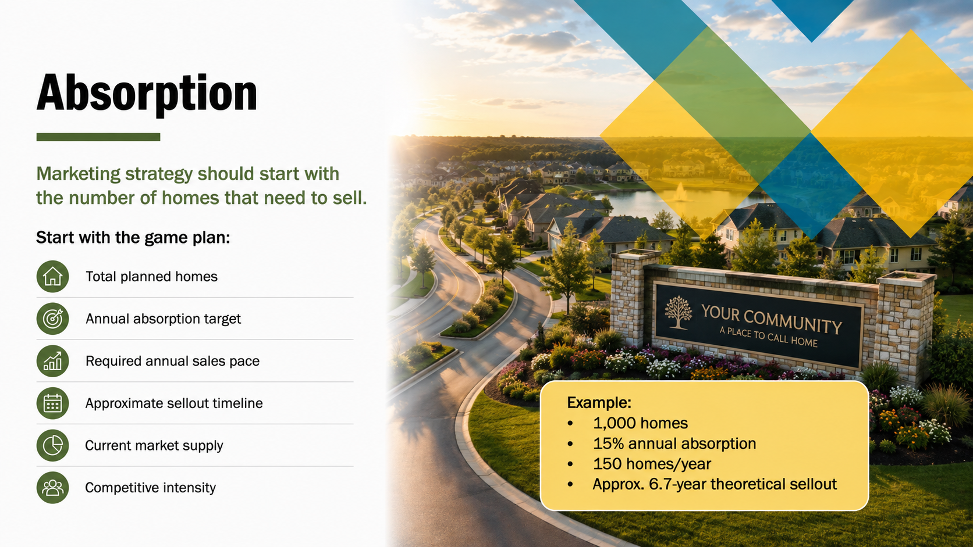
If the development needs 100 annual sales to remain on plan but the demand system is consistently supporting only 65, simply maintaining the existing marketing budget because it was approved during budgeting season can become far more expensive than increasing it.
TURN THE MODEL INTO A MARKET PLAN
DECK SLIDES
Contact Scott Steiner for more details. 281.444.4777
01/21
01/21









RESEARCH & METHODOLOGY
The 4As 2025 Billing Rate Benchmark Survey provides hourly-rate benchmarks by agency function, size and geography. Detailed rate cards are licensed, so this public calculator does not reproduce proprietary 4As rates; it uses the survey as the methodological basis for role- and workload-based costing.
Promethean's 2026 digital-agency research provides a current cross-check on blended agency pricing. The calculator uses a $150–$200/hour planning band for scoped professional-service hours rather than treating project prices as universal fixed costs.
Clutch provides a broad market view of digital strategy and marketing rates and project costs. Because its database spans many agency types and geographies, the model uses Clutch as a reasonableness check rather than the sole pricing source.
The calculator uses 5–6 months as a national balanced-market planning band while allowing the developer to enter local months of supply. Zonda reinforces that equilibrium should ultimately be calibrated market by market.
The workload hours by deliverable, $100–$200 blended service-rate band, non-platform media-mix allowance, competitiveness multipliers, dynamic 0.69% minimum floor, nonlinear premium above 30% annual absorption, and post-Year-3 taper are planning assumptions. They a should be calibrated to actual scope for detailed planning, current media rate cards, localized market conditions.
Launch costs are scoped as benchmark hours × agency rate + hard production cost estimates. Ongoing services are annual workload hours × average agency rate with a post-Year-3 taper. Paid media is modeled from community size, absorption intensity, market competitiveness, current supply conditions and home-price positioning. Google Keyword Planner, Semrush, and LinkedIn planning tools remain external calibration references for media economics. Retail home value remains an output and reasonableness guardrail.